HealFern may earn a commission if you buy through links on this page, at no extra cost to you. That does not change what we report.
Part of our Gluco Cleanse Tea overview. Last checked October 27, 2026.
Does Gluco Cleanse Tea work? No study has tested Gluco Cleanse Tea itself, so nobody can say it lowers blood sugar or body weight. The vendor sells it under the headline "Himalayan Tradition FIXES Type 2 Diabetes", lists 19 herbs with no amounts, and cites 29 "Scientific References" that are general diabetes pages, none of which tests the tea or its blend.[1]
A few of those herbs lowered glucose in small human trials. Those trials used measured extracts at doses this label never states.
On insulin, a sulfonylurea (such as glipizide or glyburide), metformin or any other diabetes medicine? Do not stop or lower it because of this tea. The sales page shows a testimonial from a man who says he came "off insulin completely" and off metformin, and no vendor page warns about low blood sugar.[1] Several herbs in the blend lower glucose, and MSKCC lists bitter melon as additive with insulin and other glucose-lowering drugs.[10] Talk to your doctor first and check your glucose more often if you try it.
Does Gluco Cleanse Tea work? The short answer
Its effect on blood sugar is unknown, because the finished tea has never been studied. What the research supports is narrower. White mulberry leaf, gymnema and triphala each lowered fasting glucose in small human trials, mostly in people who already had raised glucose.[4][6][3] Those studies used measured extracts, often for 8 to 12 weeks.
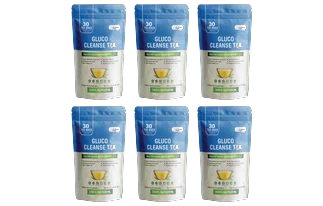
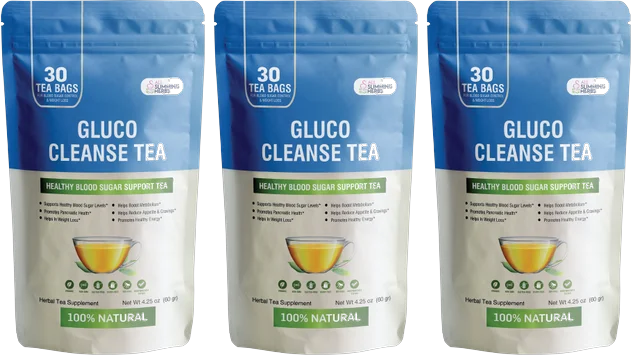
The tea gives you none of those numbers. The pouch lists 30 tea bags and "Net Wt 4.25 oz (60 gr)", two weights that do not match, since 4.25 oz is about 120 g.[1] At 60 g, each bag holds about 2 g of plant material, so 19 herbs average roughly 0.1 g each (our arithmetic).
The weight-loss promises rest on the same gap. A tea can taste fine and still fall well short of the doses research used.
Which evidence levels should you not confuse?
Four levels of evidence get blurred on supplement sales pages, and only the last two say anything about a product. Gluco Cleanse Tea reaches the second level for some herbs and never reaches the third.
Plausibility
A herb has a mechanism, lab result or animal study that fits the claim. Juniper berry sits here: its glucose effect comes from diabetic rats and lab models, and a 2019 review called for well-designed human trials.[12]
Ingredient trials
The herb, on its own, changed a measured outcome in people. White mulberry leaf has a meta-analysis of 12 trials with lower fasting glucose and HbA1c.[4] Bitter melon, which the vendor says "acts like a natural insulin", has a null meta-analysis instead.[7]
Finished-product trial
Someone tests the exact tea, at its real dose, against a placebo. Gluco Cleanse Tea has no such trial. Its refund page says the tea "has been scientifically tested" and names no test.[2]
Replication
Independent groups repeat the result. Even the better herbs here rest on small, short trials, and the triphala review asked for "large well-designed RCTs".[3]
Gluco Cleanse Tea claims vs what the evidence supports
The vendor's biggest claims do not match the human data we found. Each claim below is quoted from the sales or refund page and set against the strongest study we could cite.
| Vendor claim | Reasonable reading | Limitation |
|---|---|---|
| "FIXES Type 2 Diabetes"[1] | No herb in our sources reversed type 2 diabetes in a trial | No study of the tea; a disease claim |
| Gymnema "helps regenerate insulin-producing beta cells" | Gymnema extracts lowered fasting glucose and HbA1c in small trials[6] | Trials used 200 to 1,000 mg of extract a day; the tea's share is unknown |
| Bitter melon "acts like a natural insulin" | 9 trials pooled: glucose and HbA1c did not change significantly[7] | The pooled data contradict the claim |
| Cinnamon "significantly reduces blood sugar" | The cinnamon trials we hold measured weight; effects showed at 2 g or more a day for 12 weeks[9] | About 2 g per bag covers all 19 herbs |
| Garcinia "blocks fat production" | Pooled trials show no change in fasting glucose or insulin[11] | Does nothing for the blood sugar angle |
| "IT WILL WORK!"[2] | A promise from the refund page | No test is cited |
Our herb-by-herb grades are on the Gluco Cleanse Tea ingredients page.
Which ingredients matter most?
White mulberry leaf, gymnema, banaba and triphala carry the most human glucose data, and all four share one problem here: the tea does not say how much of each it holds. Dose, form and population all differ from the studies.
Dose. One 12-week mulberry trial set 12 mg of 1-deoxynojirimycin (DNJ), taken three times daily, as the lowest dose that blunted post-meal glucose.[5] The best banaba trial used 500 mg of extract twice daily for 12 weeks.[8] Neither amount can be checked against an unlabeled tea bag.
Form. Trials used concentrated, standardized extracts. Gluco Cleanse Tea is dried plant material steeped in water, with no extract ratio given.
Population. Triphala lowered fasting glucose in people with diabetes but not in people without it.[3] Ginseng root showed no glucose effect in people already taking diabetes drugs,[13] which describes many buyers of a tea marketed for diabetes.
What results are realistic to expect?
The best case in the trials is a small drop in fasting glucose after 8 to 12 weeks of a measured herb extract. The mulberry meta-analysis found fasting glucose down 0.47 mmol/L, about 8 mg/dL (our conversion), with larger effects at 8 weeks or more.[4] The 12-week mulberry trial found fasting glucose down 3.86 mg/dL and HbA1c down 0.11 points from baseline.[5]
No trial measured the "deep stubborn fat pockets" the guarantee box says will melt.[1] The refund page asks for 3 to 4 cups a day for at least 2 months,[2] so judge any change by your meter and an HbA1c test from your doctor, never by feel.
When should you see a doctor instead?
Talk to a doctor before you try the tea if you take any diabetes medicine, are pregnant, or have liver or kidney disease. MSKCC advises avoiding bitter melon in pregnancy and lists case reports of kidney inflammation and an irregular heartbeat.[10] Our main-site list of high blood sugar symptoms covers the warning signs in more detail.
See a doctor right away if:
- your meter reads low, or you feel shaky, sweaty, confused or faint, while using the tea with diabetes medicine
- you have heavy thirst, frequent urination or blurred vision, or your readings stay high
- your skin or eyes turn yellow, or your urine turns dark
- you had a low blood sugar episode and do not know why
Evidence conclusion
Gluco Cleanse Tea has a plausible herb list and no product evidence. The table answers the questions a buyer with blood sugar concerns should ask.
| Decision question | Current assessment |
|---|---|
| Has the tea itself been tested? | No published study of Gluco Cleanse Tea |
| Do any of its herbs lower glucose? | Some, in small trials of measured extracts |
| Can you know your dose? | No, the vendor publishes no amounts |
| Is it safe with diabetes drugs? | Not studied; added low blood sugar is possible and the vendor gives no warning |
| Can it replace your medicine? | No |
If you still want to try it, read the blood sugar safety notes first and check the refund terms, which require mailing back every bag.
Back to the Gluco Cleanse Tea overview.
Frequently asked questions
Can Gluco Cleanse Tea replace diabetes medication?
No. No study shows the tea can stand in for insulin, metformin or any other diabetes drug. Several of its herbs lower glucose, so stopping medicine or stacking the two without medical advice can cause dangerous highs or lows. Any change belongs with your doctor.
How long does Gluco Cleanse Tea take to work?
Nobody has measured it, because the tea has no trial. Herb studies that saw small fasting glucose drops ran for 8 to 12 weeks with measured extracts. The vendor asks for 3 to 4 cups a day for at least 2 months.
Is there a clinical study on Gluco Cleanse Tea?
We found none. The sales page lists 29 references, and all are general diabetes pages that do not test the tea or its 19 herbs. The refund page says the tea was scientifically tested but names no study.
Will Gluco Cleanse Tea lower my A1C?
Unknown. No trial measured the tea. A 12-week trial of a standardized mulberry leaf extract lowered HbA1c by 0.11 points from baseline, and the tea does not say how much mulberry each bag holds. Ask your doctor for an A1C test before and after.
Can Gluco Cleanse Tea cause low blood sugar?
It might if you also take diabetes medicine. Mulberry, gymnema, banaba and bitter melon lower glucose, and MSKCC says bitter melon adds to insulin and other glucose-lowering drugs. Check your glucose more often and talk to your doctor first.
Sources
- Gluco Cleanse Tea sales page. Try Gluco Cleanse Tea, read October 27, 2026.
- Refund Policy. Try Gluco Cleanse Tea, read October 27, 2026.
- Triphala for obesity and diabetes: systematic review of randomized trials (PMID 33886393). PubMed, read October 27, 2026.
- Mulberry leaf and glycemic control: meta-analysis of 12 trials (PMID 36644880). PubMed, read October 27, 2026.
- Mulberry leaf extract in obese adults with borderline diabetes: 12-week randomized trial (PMID 32147046). PubMed, read October 27, 2026.
- Gymnema sylvestre and glycemic control: meta-analysis (PMID 34467577). PubMed, read October 19, 2026.
- Bitter melon and metabolic outcomes: meta-analysis of 9 randomized trials (PMID 38274207). PubMed, read October 2, 2026.
- Banaba extract in metabolic syndrome: 12-week randomized trial (PMID 34726501). PubMed, read October 20, 2026.
- Cinnamon and body composition: dose-response meta-analysis of 12 trials (PMID 30799194). PubMed, read October 2, 2026.
- Bitter Melon. Memorial Sloan Kettering Cancer Center, read October 2, 2026.
- Garcinia cambogia and glycemic and liver markers: meta-analysis of randomized trials (PMID 39943939). PubMed, read October 27, 2026.
- Juniperus communis: review of pharmacological effects (PMID 31508527). PubMed, read October 27, 2026.
- Ginseng and glycemic control in people on diabetes drugs (PMID 26871778). PubMed, read October 20, 2026.
This page is general information, not medical advice. Dietary supplements are not reviewed by the FDA for safety or effectiveness before they are sold and are not intended to diagnose, treat, cure or prevent any disease. Talk to your doctor before taking any supplement, especially if you are pregnant, nursing, take medication or have a health condition.