HealFern may earn a commission if you buy through links on this page, at no extra cost to you. That does not change what we report.
Part of our Gluco Cleanse Tea overview. Last checked October 27, 2026.
Gluco Cleanse Tea blood sugar support is a marketing claim with no study of the tea behind it, and for people on diabetes medicine the bigger issue is safety. The vendor's site header calls it "The Only Tea Specifically Created To FIX Diabetes", lists 19 herbs with no amounts, and carries no warning about low blood sugar.[1] In small trials, white mulberry leaf lowered fasting glucose by 0.47 mmol/L, which is exactly why it can stack with your medicine.[4]
Low blood sugar warning. If you take insulin, a sulfonylurea (glipizide, glyburide, glimepiride), metformin or any other diabetes medicine, do not start this tea without your doctor, and never cut or stop your medicine because of it. Several of its herbs lower glucose. MSKCC lists bitter melon as additive with insulin and other glucose-lowering drugs.[3] If you try it, check your glucose more often, especially in the first weeks and before driving.
Does Gluco Cleanse Tea blood sugar support hold up?
Only partly, and only at the herb level. No published trial has tested Gluco Cleanse Tea on blood sugar, so the product's effect is unknown. Four of its herbs have human glucose data: white mulberry leaf, gymnema, banaba and triphala.[4][6][7][8]
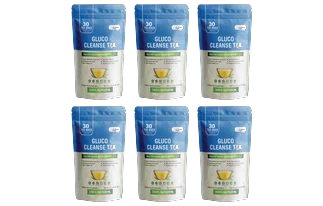
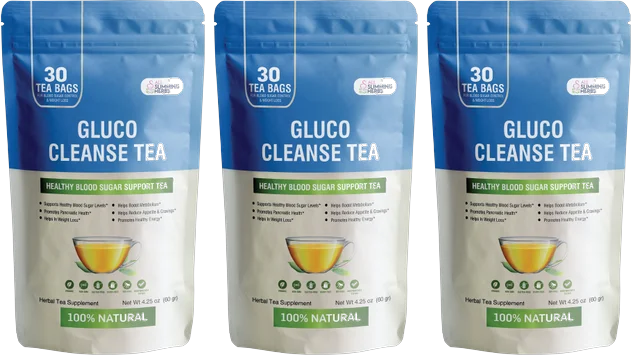
Those studies used measured extracts. The tea's pouch prints "Net Wt 4.25 oz (60 gr)" for 30 bags, about 2 g of plant material per bag at 60 g, shared by 19 herbs.[1] That is roughly 0.1 g per herb if split evenly (our arithmetic).
The sales page shows a testimonial of a man who says he came "off insulin completely" and off metformin.[1] The vendor's own disclaimer page says the presenter "Robert" is not a doctor.[2] Medicine changes are a decision for you and your prescriber, made with meter readings.
What do the facts show?
The facts show glucose-lowering herbs at unknown doses, sold to people who often take glucose-lowering drugs. The table lists the herbs with human blood sugar data and what is known about each in this tea.
| Herb | Human blood sugar finding | Dose studied | Amount in the tea |
|---|---|---|---|
| White mulberry leaf | 12 trials pooled: fasting glucose down 0.47 mmol/L, lower HbA1c[4] | 12 mg DNJ, three times daily[5] | Not disclosed |
| Gymnema | Lower fasting glucose and HbA1c in type 2 diabetes, small trials[6] | 200 to 1,000 mg extract a day | Not disclosed |
| Banaba | 10 mg corosolic acid lowered glucose 90 minutes into a glucose test[7] | 10 mg corosolic acid, single dose | Not disclosed |
| Triphala | Fasting glucose fell in people with diabetes only[8] | Not reported in the review | Not disclosed |
| Bitter melon | No significant change in pooled trials; additive with insulin per MSKCC[3] | Varied | Not disclosed |
| Garcinia cambogia | No effect on fasting glucose or insulin[12] | Varied | Not disclosed |
Why the risk is low blood sugar
Mulberry leaf lowered fasting glucose and insulin in trials, so it may add to diabetes drugs and raise the chance of a low; no interaction study exists.[5] NCCIH lists a theoretical interaction between dandelion and diabetes drugs.[13] People on insulin or a sulfonylurea already manage a risk of low readings, so an extra glucose-lowering drink leaves them less margin.
Why results may not show up
Ginseng root showed no glucose effect in people already taking diabetes drugs.[9] Trials ran 8 to 12 weeks with extracts, and the refund page asks for 3 to 4 cups a day for at least 2 months.[11] That pace empties a 30-bag pouch in about 10 days.
Caffeine
Green and oolong tea add caffeine in an unstated amount. FDA puts 400 mg a day as the level not generally linked to negative effects in most adults.[10] At 3 to 4 cups a day, that caffeine adds up with your coffee in a way you cannot measure.
How to try it with less risk
If you and your doctor decide a trial is reasonable, handle it like any change to your routine and keep records.
- Write down two weeks of meter readings before the first cup.
- Start with one cup a day, not the 3 to 4 the refund page suggests, and keep your medicine unchanged.
- Check glucose before meals and at bedtime for the first two weeks.
- Stop the tea and call your doctor after any low reading.
- Keep the pouch and every used bag, since the refund requires all of them back within 60 days.[11]
What should you check before buying?
Check your medicines, your meter and the refund terms before you order. A short list:
- Ask your doctor or pharmacist whether any of the 19 herbs conflict with your diabetes medicine.
- Agree on a plan for checking glucose more often, and what reading should make you stop.
- Get a baseline HbA1c so you can tell if anything changed after 2 or 3 months.
- Skip the tea if you are pregnant: MSKCC advises avoiding bitter melon in pregnancy.[3]
- Read the refund rules: 60 days, every bag mailed back at your cost, shipping deducted, once per customer.[11]
- Keep food basics going; our low glycemic foods list is a free place to start.
See a doctor right away if:
- you feel shaky, sweaty, dizzy, confused or have a racing heart, or your meter reads low
- you have heavy thirst, frequent urination or blurred vision; see our list of high blood sugar symptoms
- your readings change sharply after you start any new tea or supplement
Our take
Gluco Cleanse Tea names herbs with real but small glucose data and then hides the doses that would tell you whether any of it applies. For people on insulin, sulfonylureas or metformin, the missing low blood sugar warning matters more than the missing trial. If you want to compare a different format, HealFern has looked at Sugar Defender drops, and the herb-by-herb grades are on Gluco Cleanse Tea ingredients.
Back to the Gluco Cleanse Tea overview.
Frequently asked questions
Is Gluco Cleanse Tea safe for diabetics on insulin?
It has not been studied with insulin. Several of its herbs lower glucose, and MSKCC says bitter melon adds to insulin. Ask your doctor before starting, check your glucose more often, and never lower insulin on your own because of the tea.
Can I drink Gluco Cleanse Tea with metformin?
No study has tested the combination. Mulberry, gymnema, banaba and triphala lowered glucose in trials, so adding them to metformin or a sulfonylurea could push readings lower. Talk to your prescriber first and track your meter closely.
Does Gluco Cleanse Tea lower blood sugar?
Unknown, because the tea itself has no trial. Some of its herbs lowered fasting glucose in small studies of measured extracts, but the vendor does not publish how much of each herb a bag contains.
What are signs of low blood sugar while drinking Gluco Cleanse Tea?
Shakiness, sweating, dizziness, confusion and a racing heart are common signs. If you feel them, check your meter, handle a low reading the way your care team taught you, and call your doctor about the tea.
Sources
- Gluco Cleanse Tea sales page. Try Gluco Cleanse Tea, read October 27, 2026.
- Legal and Testimonial Disclaimer. Try Gluco Cleanse Tea, read October 27, 2026.
- Bitter Melon. Memorial Sloan Kettering Cancer Center, read October 2, 2026.
- Mulberry leaf and glycemic control: meta-analysis of 12 trials (PMID 36644880). PubMed, read October 27, 2026.
- Mulberry leaf extract in obese adults with borderline diabetes: 12-week randomized trial (PMID 32147046). PubMed, read October 27, 2026.
- Gymnema sylvestre and glycemic control: meta-analysis (PMID 34467577). PubMed, read October 19, 2026.
- Corosolic acid and post-challenge glucose: single-dose crossover study (PMID 16549220). PubMed, read October 20, 2026.
- Triphala for obesity and diabetes: systematic review of randomized trials (PMID 33886393). PubMed, read October 27, 2026.
- Ginseng and glycemic control in people on diabetes drugs (PMID 26871778). PubMed, read October 20, 2026.
- Spilling the Beans: How Much Caffeine Is Too Much?. U.S. Food and Drug Administration, read October 19, 2026.
- Refund Policy. Try Gluco Cleanse Tea, read October 27, 2026.
- Garcinia cambogia and glycemic and liver markers: meta-analysis of randomized trials (PMID 39943939). PubMed, read October 27, 2026.
- Dandelion. NIH National Center for Complementary and Integrative Health, read October 19, 2026.
This page is general information, not medical advice. Dietary supplements are not reviewed by the FDA for safety or effectiveness before they are sold and are not intended to diagnose, treat, cure or prevent any disease. Talk to your doctor before taking any supplement, especially if you are pregnant, nursing, take medication or have a health condition.