HealFern may earn a commission if you buy through links on this page, at no extra cost to you. That does not change what we report.
Part of our Gluco Cleanse Tea overview. Last checked October 27, 2026.
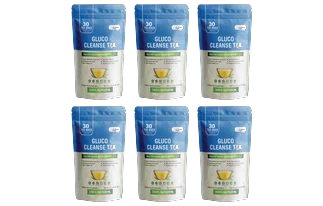
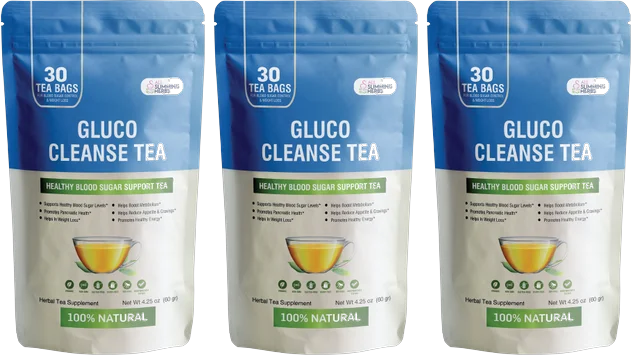
Gluco Cleanse Tea ingredients are 19 herbs named on the vendor's sales page, from gymnema and white mulberry leaf to monk fruit and peppermint, plus natural lemon and mint flavor. The vendor publishes no amount for any of them and no Supplement Facts panel.[1] Each 30-bag pouch is printed "Net Wt 4.25 oz (60 gr)", which works out to about 2 g per bag at 60 g, or roughly 0.1 g per herb on average (our arithmetic).
Several of these herbs lower blood sugar. If you take insulin, a sulfonylurea such as glipizide or glyburide, metformin or another diabetes medicine, ask your doctor before drinking this tea and check your glucose more often. No vendor page carries this warning.[1]
Gluco Cleanse Tea ingredients at a glance
All 19 herbs are named, none is dosed, and only a handful have human glucose data. Grades below are ours, based on the human studies cited further down; "Not graded" means we hold no human evidence card for that herb as a drink.
| Ingredient | Role claimed or likely | Amount disclosed? | Evidence grade |
|---|---|---|---|
| Gymnema sylvestre | Blood sugar | No | Limited |
| Triphala | Blood sugar, weight | No | Limited |
| Bitter melon | "Natural insulin" | No | Weak |
| White mulberry leaves | Blood sugar | No | Moderate for extracts, Weak at tea doses |
| Cinnamon | Blood sugar | No | Weak below gram doses |
| Turmeric | General wellness | No | Not graded for blood sugar |
| Fenugreek seeds | Blood sugar | No | Weak |
| Banaba leaves | Blood sugar | No | Limited |
| Juniper berries | Blood sugar | No | Weak (animal only) |
| Green tea | Weight | No | Weak |
| Oolong tea | "Fat burning" | No | Weak |
| Orange peel | Flavor | No | Not graded |
| Lemongrass | Flavor | No | Not graded |
| Ginger | Blood sugar, weight | No | Limited |
| Dandelion leaves | "Detox" | No | Weak |
| Ginseng root | Blood sugar | No | Limited (root data) |
| Garcinia cambogia | Appetite, fat | No | Weak |
| Peppermint | Flavor | No | Weak |
| Monk fruit | Sweetener | No | Weak |
What is in each ingredient, and what does research say?
The herbs with the most human glucose data are white mulberry leaf, gymnema, banaba and triphala, and every trial below used a measured dose. None of those doses can be matched to a Gluco Cleanse Tea bag.
Gymnema sylvestre
A leaf used in Ayurvedic medicine. Meta-analyses report lower fasting glucose and HbA1c in type 2 diabetes from small trials using 200 to 1,000 mg of extract a day.[2] LiverTox lists rare liver injury reports.[3] The vendor's claim that it regenerates beta cells has no human data in our sources.
Triphala
A mix of three dried fruits: amla, bibhitaki and haritaki. A review of randomized trials found fasting glucose fell in people with diabetes but not in people without it.[4] A Phase I trial used 2,500 mg a day of water extract.[5]
Bitter melon
A gourd the vendor says "acts like a natural insulin". A meta-analysis of 9 trials found no significant change in glucose or HbA1c.[6] MSKCC lists it as additive with insulin and advises avoiding it in pregnancy.[7]
White mulberry leaves
The best-supported herb here. A meta-analysis of 12 trials found fasting glucose down 0.47 mmol/L and lower HbA1c.[8] The minimum effective dose in one trial was 12 mg of DNJ three times daily, with bloating and loose stools as side effects.[9]
Cinnamon
Cassia cinnamon trials found small weight and fat changes only at 2 g or more a day for 12 weeks or longer.[10] NCCIH notes cassia contains coumarin, a concern for people with liver disease.[11] HealFern covers it further in cinnamon for blood sugar.
Turmeric
We hold no blood sugar trial for turmeric. NCCIH says plain turmeric is likely safe for 2 to 3 months, while high-absorption curcumin products have been linked to liver injury.[12]
Fenugreek seeds
NCCIH says the evidence is not enough to support fenugreek for diabetes and warns that large doses may cause a harmful drop in blood sugar. It is not considered safe in pregnancy above food amounts.
Banaba leaves
A 12-week trial of 500 mg extract twice daily in 24 adults with metabolic syndrome lowered fasting glucose.[13] A review found no adverse effects in controlled trials but called them small and short.[14]
Juniper berries
Glucose effects appear only in diabetic rats and lab models; a 2019 review called for human trials.[15] We found no human safety data.
Green tea
NCCIH says tea catechins and caffeine may have a modest effect on body weight. Liver injury has been reported mainly with concentrated extract pills, not brewed tea.[16]
Oolong tea
In 12 men, tea brewed from 15 g of leaf a day raised energy use by 2.9%, close to the 3.4% from caffeine alone.[17] No blood sugar trial was found.
Orange peel and lemongrass
Both read as flavor ingredients. We hold no human trial of either as a drink for blood sugar or weight, so they are not graded.
Ginger
A meta-analysis of 14 trials in overweight adults found lower fasting glucose and a borderline drop in weight.[18]
Dandelion leaves
NCCIH says there is no compelling evidence for dandelion for any health condition and lists theoretical interactions with diabetes drugs and water pills.[19]
Ginseng root
A meta-analysis found a modest fasting glucose drop,[20] but another found no effect in people already on diabetes drugs.[21]
Garcinia cambogia
Pooled trials show no effect on fasting glucose or insulin.[22] Four cases of acute liver failure were reported in women using it for weight loss.[23]
Peppermint
NCCIH finds too little research on peppermint leaf to say it helps any condition.[24] Here it adds flavor.
Monk fruit
A zero-sugar sweetener. In 30 men, a monk-fruit drink did not change glucose or insulin against sugar, aspartame or stevia.[25]
How transparent is the Gluco Cleanse Tea formula?
Not very: the names are public and the amounts are not. The vendor publishes no Supplement Facts panel, no directions panel and no extract ratios, so the whole formula works like one undisclosed blend.[1]
The only number is the net weight, and it is printed two ways. 60 g across 30 bags is about 2 g per bag; 4.25 oz is about 120 g, which would be about 4 g. Either way, if the 19 herbs were split evenly, each would get 0.1 to 0.2 g per bag. Cinnamon trials started at 2 g a day and triphala used 2,500 mg.[10][5]
We used the ingredient list on the vendor's sales page, checked October 27, 2026. Third-party sites that print different lists or invented amounts do not override the vendor.
Ingredient safety and interactions
The main risk is low blood sugar when glucose-lowering herbs meet diabetes medicine. Mulberry, gymnema, banaba, triphala and bitter melon all lower glucose, and MSKCC calls bitter melon additive with insulin and other glucose-lowering drugs.[7]
Green and oolong tea add caffeine in an unstated amount. FDA says 400 mg a day is not generally linked to negative effects for most adults, but you cannot count this tea against that.[26] Garcinia and cassia cinnamon raise liver concerns, and bitter melon should be avoided in pregnancy. Our blood sugar safety page covers the warning signs and when to call a doctor.
Do these ingredients prove Gluco Cleanse Tea works?
No. Herb trials used measured extracts in capsules for weeks, and the tea gives no amounts and has never been tested as a product. Good data for mulberry leaf does not transfer to a tea bag that may hold a fraction of a gram of it.
The full breakdown of evidence levels is in does Gluco Cleanse Tea work. Prices and refund rules, checked October 27, 2026, are on Gluco Cleanse Tea price and coupon.
Back to the Gluco Cleanse Tea overview.
Frequently asked questions
What herbs are in Gluco Cleanse Tea?
The sales page names 19: gymnema, triphala, bitter melon, white mulberry leaves, cinnamon, turmeric, fenugreek, banaba, juniper, green tea, oolong tea, orange peel, lemongrass, ginger, dandelion, ginseng root, garcinia cambogia, peppermint and monk fruit, plus lemon and mint flavor.
How much of each herb is in a Gluco Cleanse Tea bag?
The vendor does not say. With 60 g printed across 30 bags, each bag holds about 2 g of tea, so 19 herbs average roughly 0.1 g each if split evenly. The real split is unknown.
Does Gluco Cleanse Tea have caffeine?
Yes. Green tea and oolong tea both contain caffeine, and the vendor does not state the amount. People sensitive to caffeine, or drinking it 3 to 4 times a day as the refund page suggests, should count it with their coffee.
Which Gluco Cleanse Tea ingredient has the best evidence?
White mulberry leaf. A meta-analysis of 12 trials found lower fasting glucose and HbA1c with standardized extracts. Gymnema, banaba and triphala have smaller trials. None of these doses can be matched to the tea because amounts are not published.
Is bitter melon in Gluco Cleanse Tea safe?
Bitter melon adds to the effect of insulin and other glucose-lowering drugs, according to MSKCC, and should be avoided in pregnancy. A meta-analysis also found no significant glucose benefit. Ask your doctor first if you take diabetes medicine.
Sources
- Gluco Cleanse Tea sales page. Try Gluco Cleanse Tea, read October 27, 2026.
- Gymnema sylvestre and glycemic control: meta-analysis (PMID 34467577). PubMed, read October 19, 2026.
- LiverTox: Gymnema. NIH National Library of Medicine, read October 19, 2026.
- Triphala for obesity and diabetes: systematic review of randomized trials (PMID 33886393). PubMed, read October 27, 2026.
- Triphala aqueous extract in healthy volunteers: Phase I trial (PMID 31680053). PubMed, read October 27, 2026.
- Bitter melon and metabolic outcomes: meta-analysis of 9 randomized trials (PMID 38274207). PubMed, read October 2, 2026.
- Bitter Melon. Memorial Sloan Kettering Cancer Center, read October 2, 2026.
- Mulberry leaf and glycemic control: meta-analysis of 12 trials (PMID 36644880). PubMed, read October 27, 2026.
- Mulberry leaf extract in obese adults with borderline diabetes: 12-week randomized trial (PMID 32147046). PubMed, read October 27, 2026.
- Cinnamon and body composition: dose-response meta-analysis of 12 trials (PMID 30799194). PubMed, read October 2, 2026.
- Cinnamon. NIH National Center for Complementary and Integrative Health, read October 2, 2026.
- Turmeric. NIH National Center for Complementary and Integrative Health, read October 19, 2026.
- Banaba extract in metabolic syndrome: 12-week randomized trial (PMID 34726501). PubMed, read October 20, 2026.
- Banaba and corosolic acid: safety and efficacy summary (PMID 22095937). PubMed, read October 20, 2026.
- Juniperus communis: review of pharmacological effects (PMID 31508527). PubMed, read October 27, 2026.
- Green Tea. NIH National Center for Complementary and Integrative Health, read October 27, 2026.
- Oolong tea and 24-hour energy expenditure in men (PMID 11694607). PubMed, read October 27, 2026.
- Ginger and anthropometric and glycemic measures: meta-analysis of 14 trials (PMID 29393665). PubMed, read October 2, 2026.
- Dandelion. NIH National Center for Complementary and Integrative Health, read October 19, 2026.
- Ginseng and glucose control: meta-analysis (PMID 25265315). PubMed, read October 20, 2026.
- Ginseng and glycemic control in people on diabetes drugs (PMID 26871778). PubMed, read October 20, 2026.
- Garcinia cambogia and glycemic and liver markers: meta-analysis of randomized trials (PMID 39943939). PubMed, read October 27, 2026.
- Acute liver failure with Garcinia cambogia: case reports (PMID 29802521). PubMed, read October 27, 2026.
- Peppermint Oil. NIH National Center for Complementary and Integrative Health, read October 19, 2026.
- Monk fruit, stevia, aspartame and sucrose drinks: glucose, insulin and energy intake (PMID 27956737). PubMed, read October 27, 2026.
- Spilling the Beans: How Much Caffeine Is Too Much?. U.S. Food and Drug Administration, read October 19, 2026.
This page is general information, not medical advice. Dietary supplements are not reviewed by the FDA for safety or effectiveness before they are sold and are not intended to diagnose, treat, cure or prevent any disease. Talk to your doctor before taking any supplement, especially if you are pregnant, nursing, take medication or have a health condition.